

Beginner Music Theory Book for Guitarists
$24.00
The music theory book for guitarists who are done with piano-first explanations. Eleven chapters built from the fretboard up, so every idea lands somewhere on the neck. No staff notation required. 60 pages, instant PDF download.
Description
Most theory books are written for piano players and then handed to guitarists. That’s the actual problem. This is a music theory book for guitarists, built from the fretboard up, so every concept lands somewhere on the neck instead of floating around as a rule you can recite but never use.
You’ve probably been through the cycle already. You learn the major scale formula. You can say it out loud. Then a G7 goes by and you still don’t know what to play over it. The information was never missing. The translation was.
Why guitar music theory has to be taught differently
Piano is linear. One note, one key, left to right. Guitar is a grid. The same note shows up in five places, and the shape you reach for changes depending on where you grab it. When you learn theory from material built for a keyboard, you get the concept without the map.
That gap is why so many players who understand theory on paper still freeze on the neck. Every chapter here closes it. You get the concept, then where it lives on the fretboard, then something to play.
What’s inside
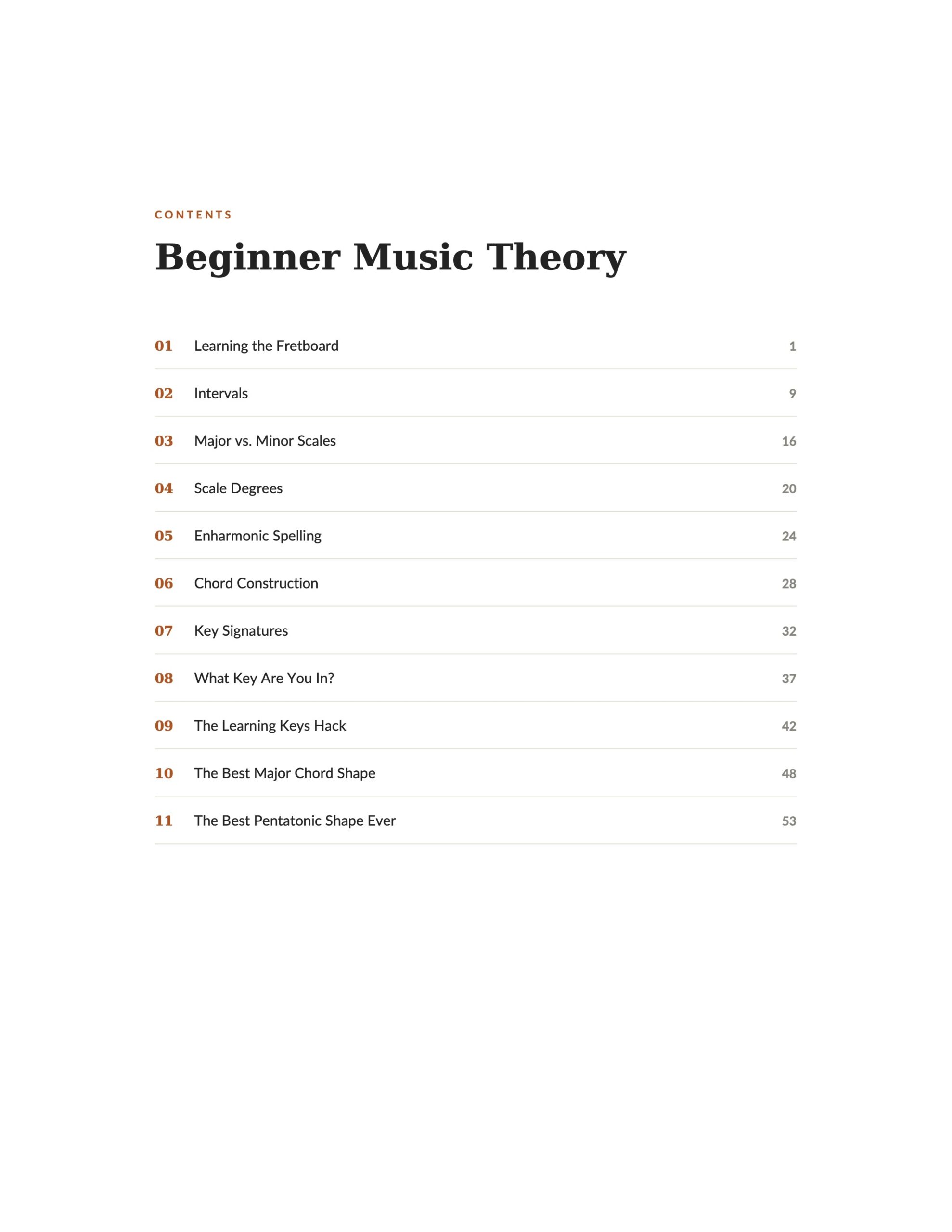
Eleven chapters, 60 pages, in order. Each one builds on the last, so read it front to back the first time.
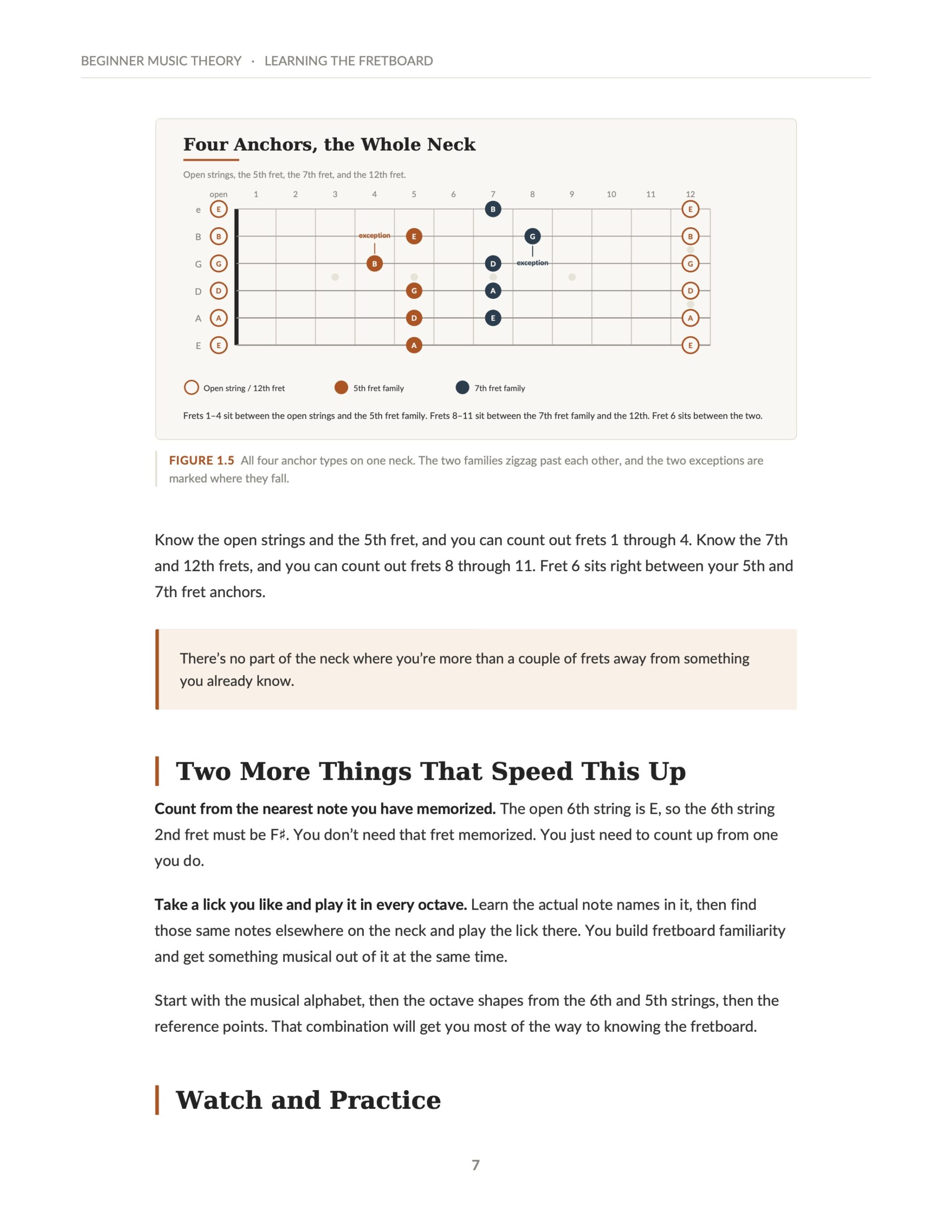
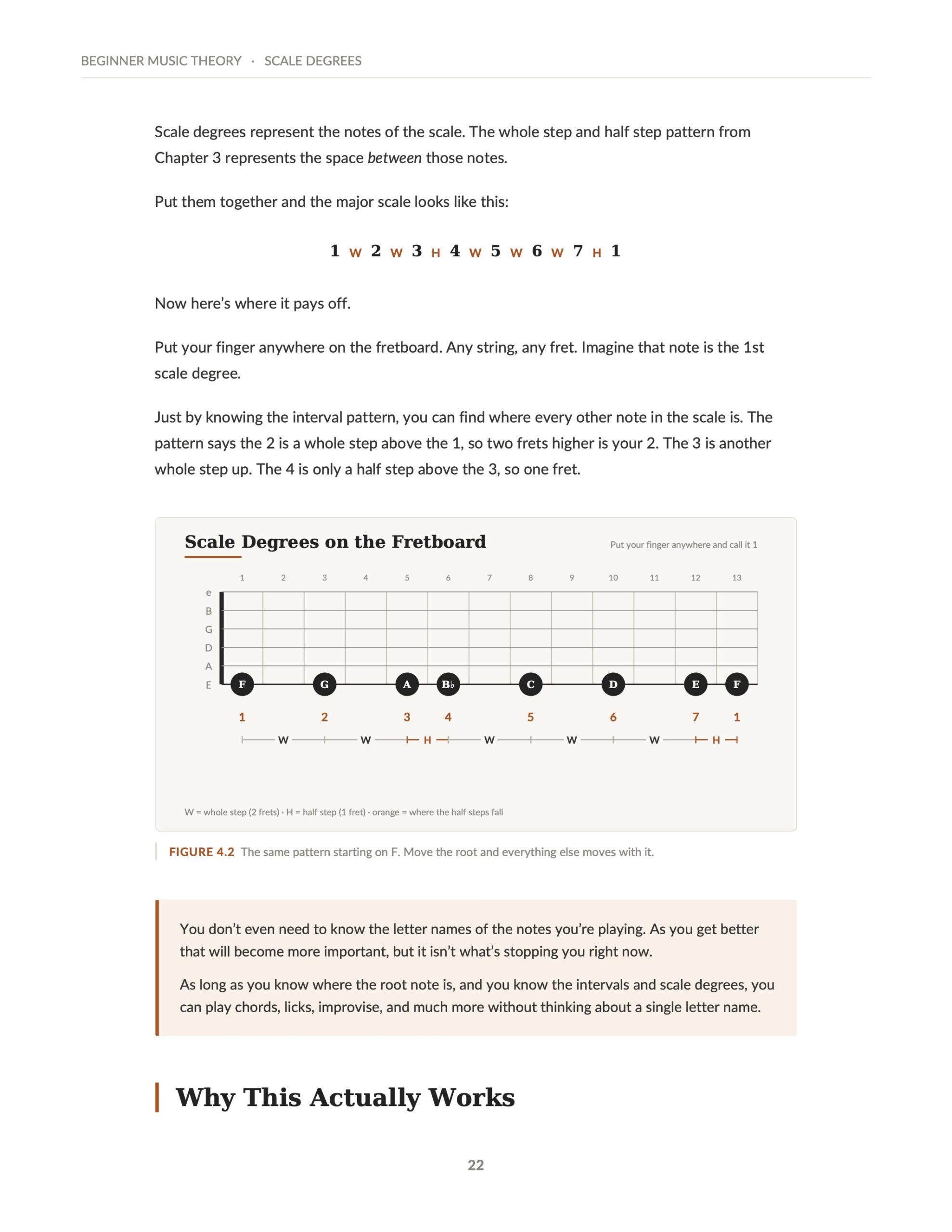
- Learning the Fretboard. Four anchor points that let you count out any note without memorizing all 144 of them.
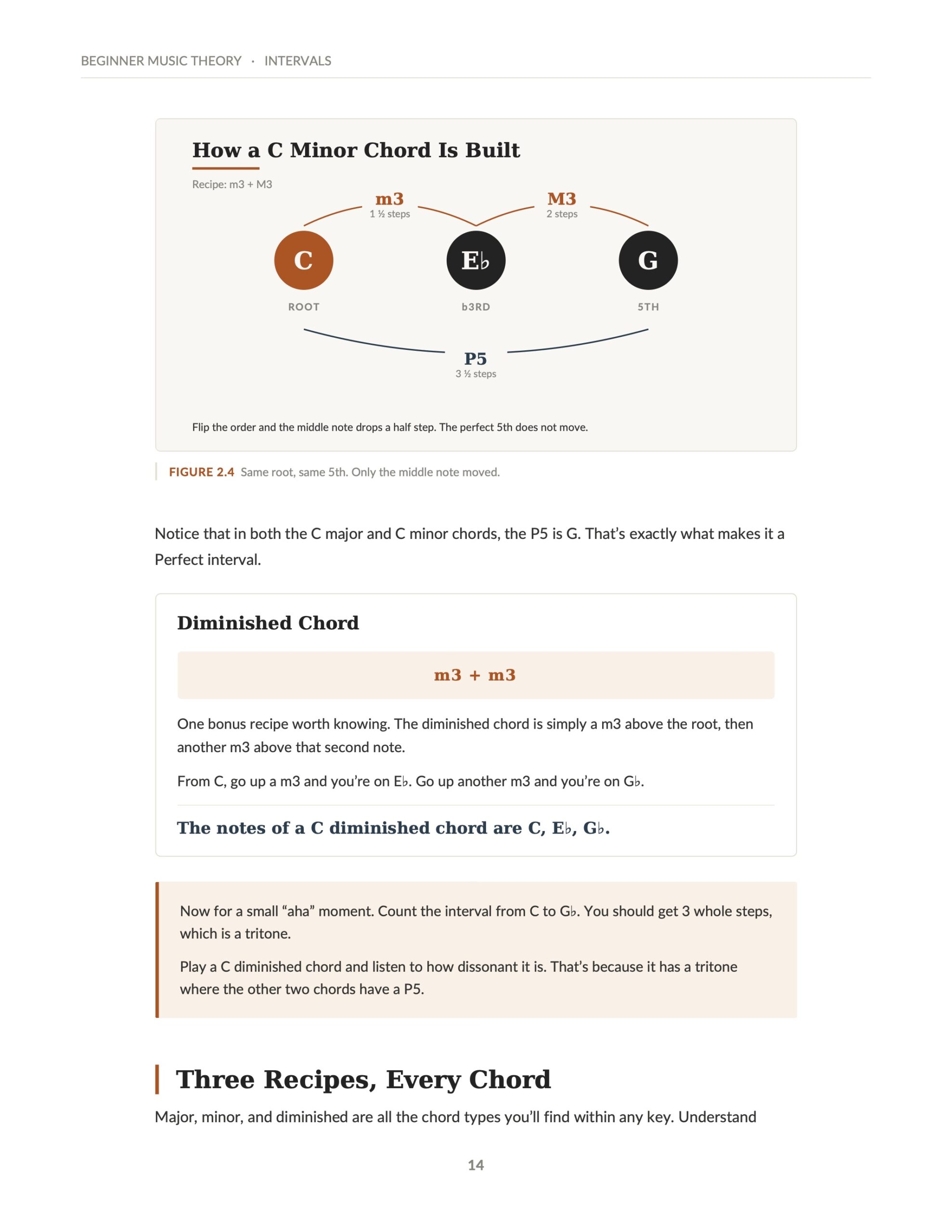
- Intervals. The distance between two notes, and why this is the one thing you actually have to understand.
- Major vs. Minor Scales. What separates them, in sound and in shape.
- Scale Degrees. Numbers instead of note names, which is how working musicians talk about music.
- Enharmonic Spelling. Why F sharp and G flat are not interchangeable, and how spelling notes correctly makes keys obvious.
- Chord Construction. Building chords out of scales instead of memorizing shapes off a chart.
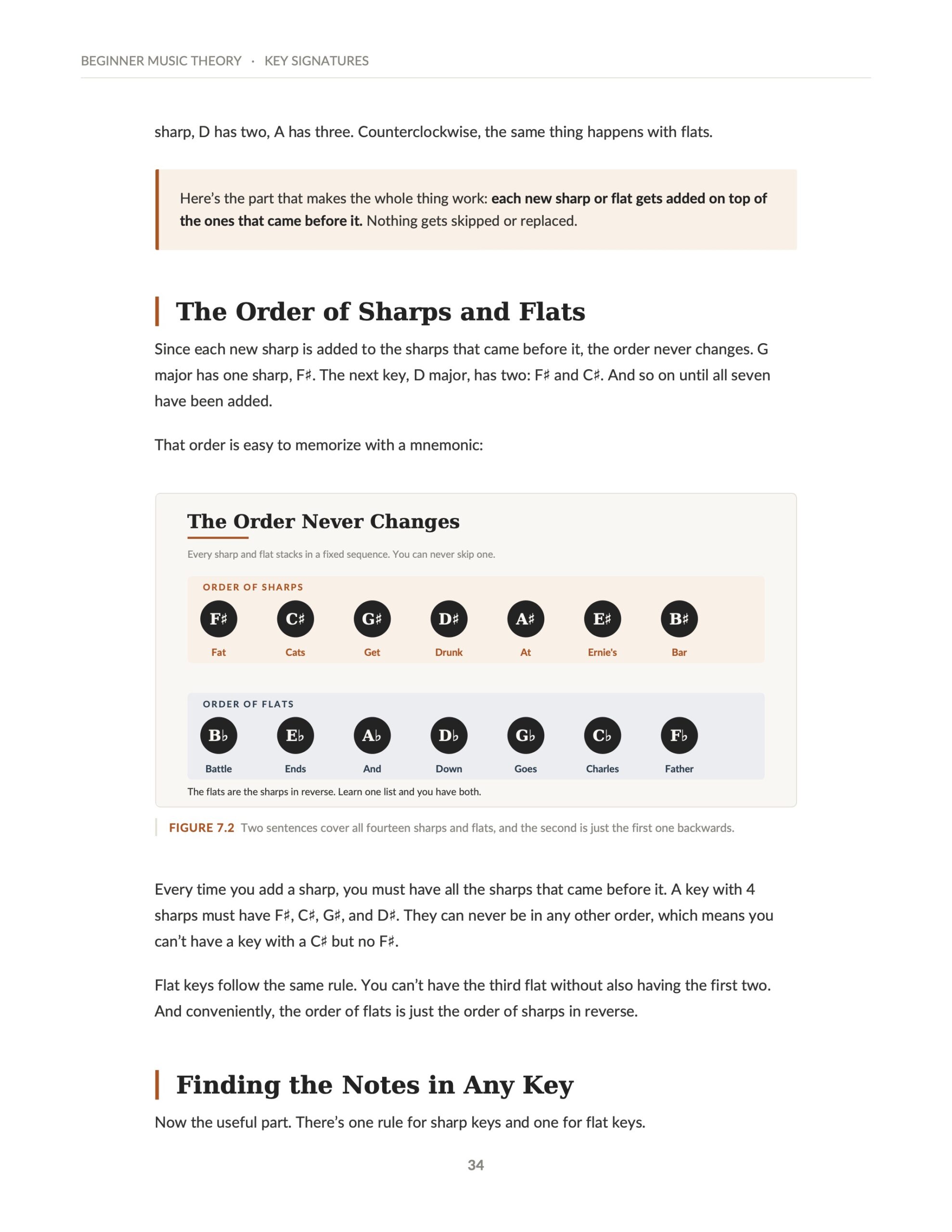
- Key Signatures. A system, not twelve lists to memorize.
- What Key Are You In? Working it out from the chords in front of you.
- The Learning Keys Hack. Two major chords a letter apart can only ever be one thing. Once you see it, you can name most keys in seconds.
- The Best Major Chord Shape. A shape most players never learn, and a reason to actually use it.
- The Best Pentatonic Shape Ever. One diagonal line, three octaves, no position shifting.
Who this music theory book for guitarists is written for
Players who’ve been at it a while and are tired of guessing. You can play. You have songs under your fingers. You just want to know why the things you’re playing work, so you can build your own instead of borrowing everybody else’s.
It also works if you’re newer and you’d rather learn this correctly the first time than unlearn it later.
No staff notation anywhere in the book. If you can read a chord chart and a fretboard diagram, you’re set.
What you get
A 60-page PDF, delivered the second you check out. Read it on a tablet at your practice chair, on your phone, or print it. Yours to keep, no expiration, download it as many times as you want.
Written by Max Rich, conservatory-trained classical guitarist with a direct Segovia teaching lineage. More free lessons on the YouTube channel.
Common questions
Do I need to read music? No. There’s no staff notation in the book.
What if I already know some theory? Chapters 1 through 5 will move fast for you. Chapters 6 through 11 are where most intermediate players find the holes.
Is this music theory book for guitarists tied to a style? No. It’s built on how the guitar is laid out, so it applies whether you play blues, rock, jazz, or classical.
Included free with Hand Mechanics
Hand Mechanics members get this book at no extra cost, plus Books Two and Three when they land. If you were going to buy it anyway, the membership costs less per month and includes the monthly workshop, the full tab library, and every article.