

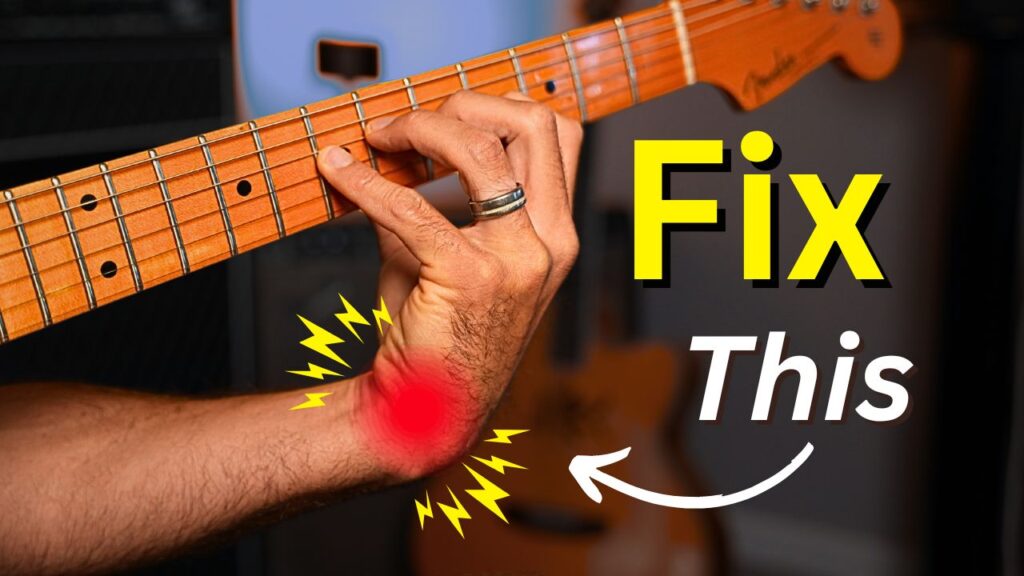
One thing is for sure: guitar hand pain is something almost every player deals with at some point. Maybe it was building your callouses when you first started out, or, more likely, it’s a recurring ache in your picking hand or fretting hand.
Here’s the truth most players never hear. Unless the pain is coming from getting your fingers calloused, you shouldn’t be hurting when you play guitar.
Pain is simply a signal that something is wrong, and it’s a signal you should listen to. So whatever you do, don’t play through it. Playing through pain can lead to injury and keep you off the guitar for a lot longer than you’d like.
Believe it or not, there’s a right way and a wrong way to approach guitar technique. Humans are biomechanical beings; we’re all built in roughly the same way, with nearly identical physiology. Same bones, same muscles, same tendons. That shared structure is the foundation of how we move on the instrument, and when you force your hands into positions they aren’t built to hold, you’re going to play poorly and maybe even injure yourself.
Pain almost always traces back to one of three things: where your wrist sits, how much tension you’re holding, or which muscles you’re using to move. Let’s take them one at a time.
The most common culprit: your wrist
The most common spot for pain is the wrist of your fretting hand. The pain might not be located there, but the root of it almost certainly is.
So how do you sit when you play? Both feet flat on the ground, the guitar over your right leg, the neck parallel to the floor? This is one of the most common positions, and honestly one of the worst.
When you sit this way, the neck sits at such a low angle relative to your hand and arm that you’re forced to hunch over the guitar, dipping your left shoulder down so your hand can get underneath the neck. The instinct is to bring your hand below the neck so you can reach the lower strings and stretch across more frets.
If that’s you, go ahead and sit that way right now and make a six-string barre chord. You’ll notice your wrist is bent heavily, almost at a 90 degree angle. That is the source of your pain.
Want to feel it for yourself? Hold your arm up so your fingers point at the ceiling and your palm faces the wall, like you’re about to high-five someone. Keep your wrist straight and wiggle all your fingers dramatically, through every extreme position you can find. Now bend your hand as hard as you can at the wrist until your palm faces the floor, and try to wiggle your fingers the same way.
Notice how much harder it just got? That’s exactly what’s happening when you play with an extreme wrist bend, which is usually caused by the guitar sitting too low.
The fix
To remedy this, raise the neck of the guitar so it sits at an angle. Think of the position a classical guitarist sits in. You don’t need a footstool, and you don’t have to put the guitar on your left leg (though that’s one way to solve it), but you should definitely elevate the neck.
Bringing the neck up from parallel to something closer to a 45 degree angle does several things at once:
- Better posture. The fretboard now sits closer to eye level instead of down at your waist, so you stop hunching. Hunching curls your shoulders and pulls your neck, back, and shoulder muscles into the work. Sit like that long enough and those muscles fatigue, which forces you to recruit more arm and forearm muscles to compensate, and that stress lands right on your wrist and fingers.
- A straight wrist. Elevating the fretboard lets your arm come up from below the neck, which leaves your wrist straight or nearly straight. When you bend hard at the wrist, you’re basically pinching off the tendons that control your fingers as they pass through the carpal tunnel. A straight wrist lets those fingers move unimpeded.
- Fewer injuries. Bending at the wrist under that kind of tension is exactly how players end up with tendonitis or carpal tunnel syndrome. Keeping the wrist straight is the surest way to avoid both.
If the low neck is your problem, there are a few ways out. You can cross your right leg over your left for a little elevation, though it won’t get you all the way to eye level. Some players use a strap even while sitting; others use a pillow or a guitar-specific support pad to lift the neck. Whatever method you choose, the goal is the same: keep your wrist straight. That’s nearly impossible in the standard right-leg position.
When the pain is a burn: tension and fatigue
There’s a second kind of hand pain, and it shows up as a burn. Have you ever held a barre chord so long that the muscle between your thumb and index finger starts to burn? Have your hands ever cramped up as you fought to play through it?
That’s muscle fatigue, and it comes from one thing: unreleased tension.
Here’s the part most players get backwards. Fatigue is not the cause of inefficiency; it’s the effect of inefficiency. It’s a symptom, and one you need to pay close attention to.
So where does that tension actually come from? Here’s what’s really going on, and it’s simpler than most people think.
Every time you fret a note, a muscle contracts and pulls your finger down through a tendon, then holds it there. The muscles that move your fretting fingers aren’t even in your fingers; they’re up in your forearm, connected to each finger by long tendons that run through your wrist. To hold that note down, the muscle stays contracted and the tendon stays loaded under tension.
The problem is what happens between notes. Most players never fully unload the tendon. They ease off a little, but they never let it go all the way back to slack before the next movement, so a little bit of load stays in the system. Then a little more. Then a little more. Nothing ever resets to zero.
That leftover load means the muscle never actually switches off. And a muscle held in constant contraction squeezes down on its own blood vessels, choking off the fresh, oxygen-rich blood it needs to keep going. It’s like holding your breath and feeling your lungs begin to burn. The longer you go without fully releasing, the hotter that burn gets, and a muscle pushed that far can eventually seize into a cramp.
Once that cramp hits, there’s almost nothing you can do but stop. And notice that the decision isn’t even yours anymore. Your body locks the muscle up and forces you to relax. That’s its natural defense against muscle damage, which is exactly why it’s a far better idea to avoid the cramp in the practice room than to have it ambush you on stage.
What to do when you feel it
The very first thing, no matter where you are in the song or how close you are to a clean repetition: stop. (And it won’t be a clean rep anyway, because it’s all about to collapse.)
Then raise the cramped hand straight up in the air and let the blood drain out of your arm. This flushes the capillaries of any blood that may be carrying inflammatory compounds. After about 30 seconds, drop your arm straight down, relax for another 30 seconds, and feel the rush of fresh blood flow back in. It’s like an energy shot for your muscle tissue. Flushed with fresh oxygen, the muscle feels rejuvenated and is soon ready to go again.
One warning: don’t just play through it. Every time you push through fatigue, you inflame the muscle tissue and shorten the next round of practice, so you fatigue again, and faster each time.
How to keep it from happening
The real goal is to avoid the fatigue altogether by constantly releasing tension between movements. When you shift chords, relax. When you change fingers, relax. When you finish a pick stroke, relax. Stay conscious of how much tension is in your hands at all times, because that tension is the warning light telling you fatigue is on the way.
The hidden cause: using the wrong muscles
There’s no way to play without using your muscles, obviously. But not every muscle is built for every job, and a lot of pain, cramping, and stiffness comes from using the wrong one for a given motion.
Try to alternate pick quickly on a single string by pivoting from your elbow, and you’re using muscles that were never designed for a movement that fine and small. Strum chords from your wrist and you’ll end up with wrist pain, inflammation, or at best bad rhythm and missed strings. And if you feel pain in your fretting hand, in the palm or the fingers, you’re almost certainly using the wrong muscles there too.
A lot of it comes down to how you use the knuckles in your fingers. Think of your knuckles as the controls for where your fingertip ends up.
Keep the big knuckle still and bend only the middle and small knuckles, and your fingertip curls from pointing away from your palm to tucking into it. On the guitar, that’s how you control vertical distance, meaning your string changes. Move only the big knuckle and your fingertip keeps pointing the same direction, roughly at the ceiling, but it travels closer to the fretboard. That’s how you move toward and away from the strings.
The trouble starts when you use both at once when you only needed one. Say you’re playing hammer-ons and you let the middle and small knuckles get involved. As you pull away from the string, you’re now pointing the fingertip away from its target. To hammer back on, you have to realign all three knuckles while the finger is still traveling through the air. That forces you to slow down and guide the finger back to the landing zone, and that guiding tightens the muscles in your hand and leaves you stiff. Multiply that by the thousands of movements in a single song and it’s easy to see where the cramping and stiffness come from.
What Guitar Hand Pain Really Means
Notice what connects all three of these. The wrist, the tension, the knuckles: every one of them is your hands being forced to work harder than the motion actually requires.
And the fix in every case starts the same way. Learn how your muscles and joints are actually built to move, then pay very close attention to how much tension you’re holding and where you’re holding it while you play. Tension itself isn’t the enemy; unreleased tension is. Some tension is necessary, but you have to learn to release it the instant each motion is done. That’s an internal task, something you have to learn to feel.
Nobody ever said getting better would be easy. But for me, learning how my body is designed to move advanced my playing faster than anything else. Once I could compare efficient motion to inefficient motion, I could diagnose my own technical problems and teach myself how to fix them.
And whatever you do, don’t fight through the discomfort. If it’s uncomfortable, you’re doing something wrong. Pay attention to what that might be, and you’ll be able to find and fix the flaw.
That last part, figuring out which of these three is actually causing your pain, is the hard part to do alone, because the breakdown is usually happening faster than your eye can catch. That’s the whole idea behind a Biomechanics Video Analysis. You send me video from a few angles, and I go through it frame by frame to pinpoint the exact moment and position where your mechanics break down, then tell you what’s causing it and what to fix first. If your hand has been hurting and you can’t tell why, it’s the fastest way to find out.
