

Most guitar players learn chords like this:
They memorize shapes…
use them for years…
and never really know what they’re playing.
That works—up to a point.
Then eventually you hit a wall:
your playing feels boxed in
your chord choices all sound the same
writing music feels like guesswork
And the real problem isn’t your technique.
It’s that you were never shown how chords actually work.
So let’s fix that—quickly.
The 3 Notes That Control Every Chord
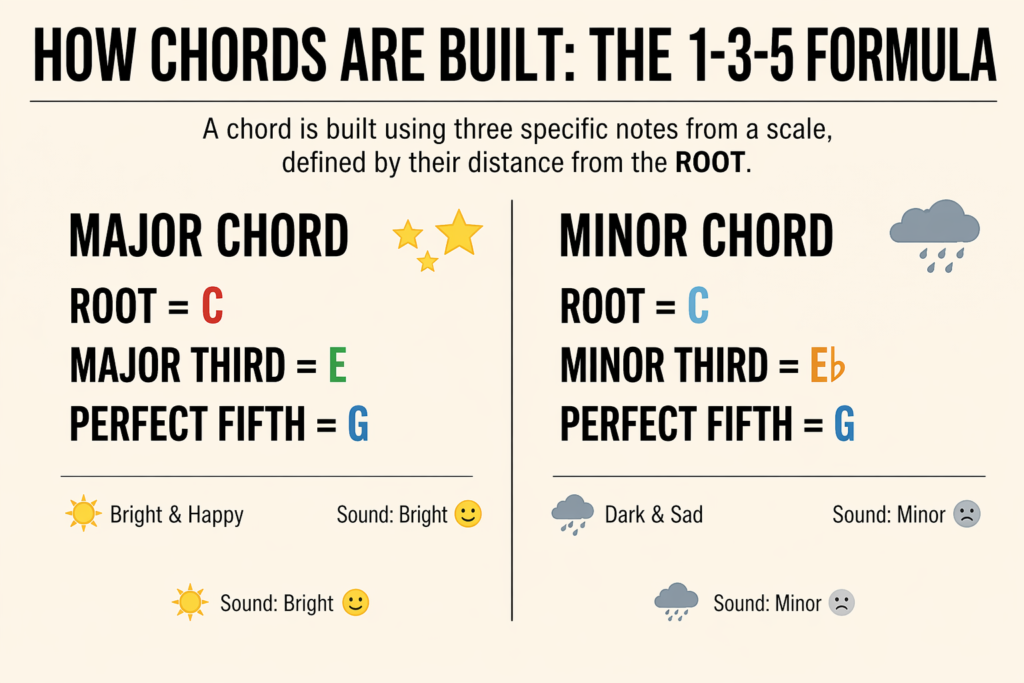
Every major or minor chord is built from just three things:
the root (1)
the third (3)
the fifth (5)
That’s it.
If you understand what those notes are doing, you’re no longer stuck relying on shapes—you can start controlling sound.
A 30-Second Test
Play a C on the 3rd fret of the A string.
Now:
go up 4 frets → you land on E
go up 3 frets instead → you land on Eb
That one fret difference is the entire reason chords sound major or minor.
Major = brighter, more stable
Minor = darker, more tense
Same root. One note changed.
That’s how much control you actually have—once you know where to look.
Now let’s build a chord
Take the C major scale:
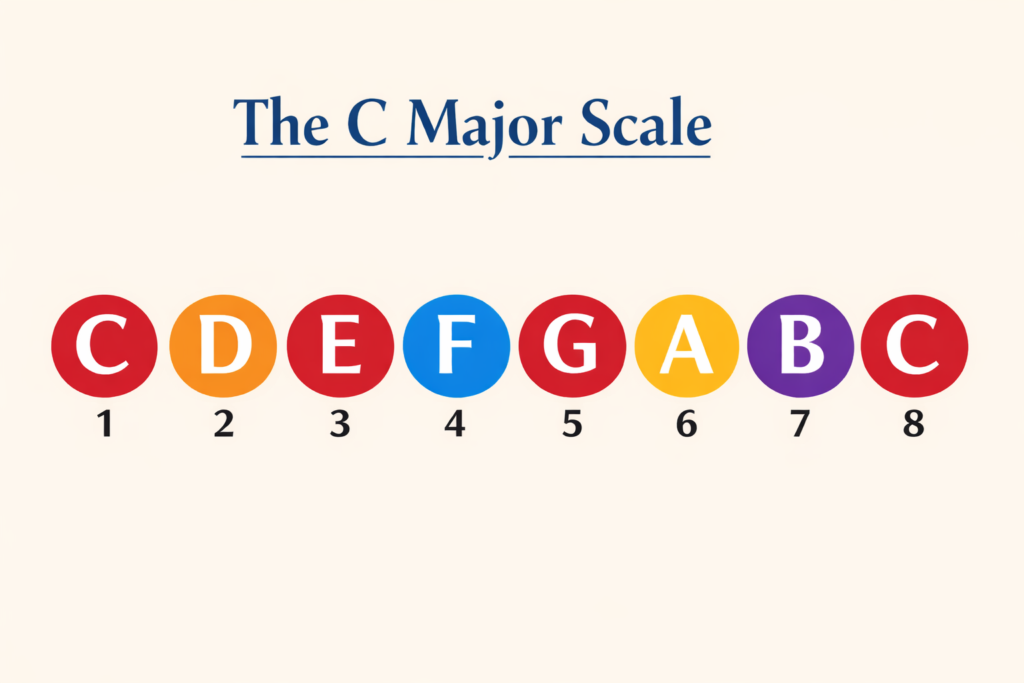
To build a C chord, you don’t need a shape.
You just take:
C (1)
E (3)
G (5)
That’s the chord.
Now here’s where it starts to open up.
Try This Once
Take any chord you already know—G, D, whatever.
Instead of just playing it, ask:
-
where is the root?
-
where is the third?
-
where is the fifth?
Most players have never actually looked at their playing this way.
And that’s usually the point where things start to change.
Because once you can see those notes, you can start:
-
modifying chords
-
building your own voicings
-
understanding why something sounds right (or off)
We’ll take this further next week, because there’s one chord in every key that doesn’t behave like the others—and it’s the key to understanding tension and resolution.
Before that, if you want to see this visually on the fretboard, I put together a quick breakdown you can watch here.
This is one of those things that clicks much faster when you see it.
If you’ve never approached chords this way before, you’ll probably notice your awareness shift immediately.
Keep going with this—there’s more to unlock here.
Max Rich
